
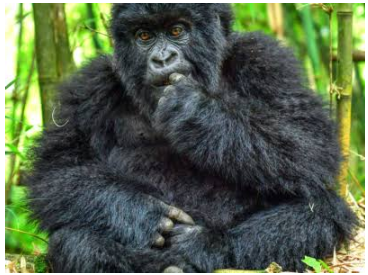

Rwanda is a small country, but it holds an outsized share of the world’s remaining great apes. Its misty volcanic slopes and ancient rainforests shelter two of humanity’s closest living relatives: the mountain gorilla and the eastern chimpanzee. Decades of conservation work, strong government commitment and carefully managed tourism have turned Rwanda into one of the clearest examples of how protecting wildlife can also support people.
This guide covers the great apes of Rwanda: which species live there, where to find them, how they are protected, and how to see them responsibly.
What Are Great Apes?
Great apes are the large-bodied members of the primate family Hominidae: gorillas, chimpanzees, bonobos, orangutans and humans. They share a large proportion of our DNA, live in complex social groups, use tools, and show emotion, memory and problem-solving ability.
Only two of the non-human great apes live in Rwanda:
- Mountain gorillas (Gorilla beringei beringei)
- Eastern chimpanzees (Pan troglodytes schweinfurthii)
Rwanda has no bonobos or orangutans, which live in the Democratic Republic of Congo and Southeast Asia respectively.
Mountain Gorillas of Rwanda
Who They Are
Mountain gorillas are the largest living primates after their lowland cousins. They have thick, dark fur suited to cold, high-altitude forests, and adult males, called silverbacks, develop a saddle of silver-grey hair on the back as they mature. A silverback can weigh well over 150 kilograms and leads a family group that may number from a handful to more than 20 individuals.
They are largely gentle herbivores. Their diet is mostly leaves, stems, shoots and bamboo, along with some fruit, and they spend much of the day feeding, resting and grooming.
Where They Live
Rwanda’s gorillas live in Volcanoes National Park in the northwest, part of the wider Virunga Massif that Rwanda shares with Uganda and the Democratic Republic of Congo. The park is a short drive from the town of Musanze, and its slopes of bamboo, hagenia forest and alpine meadow rise toward five volcanic peaks.
The only other place on Earth where mountain gorillas live is Uganda’s Bwindi Impenetrable Forest. Together, the Virunga and Bwindi populations make up the entire global population of roughly a thousand animals.
A Conservation Comeback
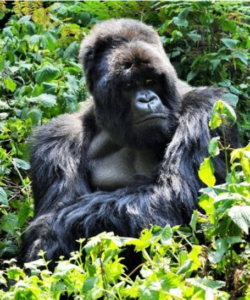
Mountain gorillas were once on the brink of extinction. Poaching, snares, habitat loss and civil conflict drove numbers down through the 20th century. By the 1980s, only a few hundred remained in the wild.
Their recovery is now one of the most cited conservation successes in Africa. Numbers have climbed steadily, and the IUCN has moved the subspecies from Critically Endangered to Endangered. The species remains vulnerable to disease, habitat pressure and human conflict, so protection must continue.
Chimpanzees of Rwanda
Nyungwe National Park
Nyungwe National Park in southwestern Rwanda is one of the oldest and largest montane rainforests in Africa. It is home to an estimated few hundred eastern chimpanzees alongside a remarkable list of other primates, including colobus monkeys that gather in troops of dozens or even hundreds.
Chimpanzees are highly social, live in large communities, and are known for tool use, hunting and complex social politics. They are omnivores that feed mainly on fruit, but also eat leaves, insects and occasionally small animals.
Chimpanzee tracking in Nyungwe usually starts before dawn so that trackers can find the animals as they wake and move. The experience is more unpredictable than gorilla trekking, since chimpanzees travel quickly and cover large areas.
Gishwati-Mukura National Park
The smaller Gishwati-Mukura National Park protects fragments of forest that were once heavily degraded. It supports a small chimpanzee population and is a showcase for forest restoration, including community-led replanting. It receives fewer visitors, which suits travelers who want a quieter experience.
Gorillas vs Chimpanzees: Key Differences
| Feature | Mountain Gorillas | Eastern Chimpanzees |
| Main location in Rwanda | Volcanoes National Park | Nyungwe, Gishwati-Mukura |
| Diet | Mostly herbivorous | Omnivorous, fruit-heavy |
| Social structure | Family groups led by a silverback | Large, fluid communities |
| Movement | Slow, ground-based | Fast, climbs and swings |
| Tourist experience | Predictable, one hour with a group | More variable, depends on finding them |
The Dian Fossey Legacy
No discussion of Rwanda’s great apes is complete without Dian Fossey. The American primatologist established the Karisoke Research Center in the Virunga volcanoes in 1967 and spent nearly two decades studying and defending mountain gorillas, often from poachers. Her work drew global attention to their plight, and her death in 1985 remains a defining moment in the history of conservation.
Karisoke continues today as a research and conservation hub, now run by the Dian Fossey Gorilla Fund. Its teams carry out daily monitoring, health checks, ecological research and community programs, and its long-term data are a cornerstone of gorilla science.
How Rwanda Protects Its Great Apes
Rwanda’s approach combines several elements:
Tourism-funded conservation. Gorilla permits are priced high to limit visitor numbers while funding park management. Rwanda charges USD $1,500 per person for a gorilla permit, and a portion of revenue is shared with communities near the parks. dumaexplorer
Strict visitor rules. Only habituated groups can be visited, group sizes are capped, visits are limited to one hour, and visitors must keep a minimum distance. Anyone showing signs of illness may be refused entry, because gorillas are susceptible to human respiratory diseases.
Veterinary care and monitoring. Specialist teams monitor gorilla health, treat injuries from snares and respond quickly to disease outbreaks.
Anti-poaching patrols. Rangers and trackers visit gorilla groups daily, removing snares and keeping watch for threats.
Community benefit. Revenue sharing has funded schools, clinics, water projects and cooperatives, which gives local people a direct stake in protecting the forest.
Kwita Izina. Each year, Rwanda holds a gorilla naming ceremony, a cultural celebration where newborn gorillas are given names. It reinforces national pride in conservation and draws international attention to the animals.
Seeing Great Apes in Rwanda: Practical Information
Gorilla Trekking
Treks begin at park headquarters, where visitors are assigned to a gorilla family based on fitness and preference. Hikes can last from 90 minutes to 6 hours depending on where the family has moved. Once you reach the group, you spend one hour observing them from a short distance. dumaexplorer
Success rates are high. Trekkers see gorillas on roughly 95% to 99% of treks. dumaexplorer
The minimum age is 15. Permits should be booked 3 to 6 months in advance, particularly for dry-season travel. dumaexplorer
Chimpanzee Tracking
Chimpanzee tracking costs considerably less than gorilla trekking and is offered in Nyungwe. Visitors set out in small groups with trackers who locate the chimpanzees by sound and sign. Sightings are not guaranteed, but the forest itself, with its canopy walkway, waterfalls and rich birdlife, is a reward in its own right.
Best Time to Visit
Both gorillas and chimpanzees can be seen year-round. The drier months, roughly June to September and December to February, offer easier hiking conditions. The wetter months, from March to May and October to November, bring muddier trails and lower visitor numbers.
What to Bring
- Sturdy waterproof hiking boots
- Long trousers and long-sleeved tops
- Gardening gloves for gripping vegetation
- A waterproof jacket and layers
- Insect repellent, sunscreen and a hat
- A camera suitable for low light (flash is not allowed)
Consider hiring a porter. It helps you on steep terrain and supports a local family.
Responsible Great Ape Tourism
Great ape tourism works only when it is done well. To protect the animals:
- Maintain the required distance and never touch the animals
- Keep your voice low and avoid sudden movements
- Do not eat or drink near the apes
- Stay home if you are unwell
- Choose operators who follow park regulations, employ local staff and support conservation
Respectful behavior safeguards the animals from disease and stress and keeps the model sustainable.
Conclusion
The great apes of Rwanda tell a story of how conservation can succeed when science, government policy and local communities work together. Mountain gorillas, once close to extinction, are now recovering in Volcanoes National Park, while chimpanzees thrive in the ancient forests of Nyungwe and the regenerating habitat of Gishwati-Mukura. Seeing them in the wild is a privilege, and it is also a contribution: every permit helps keep these animals and their forests alive. Go prepared, follow the rules and take your time, and the experience will stay with you long after you leave.
Key Takeaways
- Rwanda is home to two great ape species: mountain gorillas and eastern chimpanzees.
- Mountain gorillas live in Volcanoes National Park, while chimpanzees live in Nyungwe and Gishwati-Mukura.
- Mountain gorillas have recovered from near extinction and are now classified as Endangered, not Critically Endangered, but remain vulnerable.
- Dian Fossey’s Karisoke Research Center remains central to gorilla research and protection.
- A Rwanda gorilla permit costs $1,500, with treks lasting from about 90 minutes to 6 hours and one hour with the gorillas.
- The minimum trekking age is 15, and permits should be booked 3–6 months ahead.
- Strict rules, community benefit sharing and daily monitoring help keep great ape tourism sustainable.
Frequently Asked Questions
- What great apes live in Rwanda?
Mountain gorillas and eastern chimpanzees. Rwanda has no bonobos or orangutans. - Where can I see gorillas in Rwanda?
Volcanoes National Park, near Musanze, about a two-hour drive from Kigali. - Where can I see chimpanzees in Rwanda?
Mainly Nyungwe National Park, with a smaller population in Gishwati-Mukura National Park. - How much is a gorilla permit in Rwanda?
$1,500 per person for foreign visitors. Check with the Rwanda Development Board or a licensed operator for current rates. - How long do you spend with the gorillas?
One hour once you find the family. - Is gorilla trekking difficult?
It can be. Terrain is steep and often muddy, and trekking time varies. Porters are available, and guides assign families by fitness level. - Are mountain gorillas still endangered?
Yes. They are classified as Endangered. Their numbers are rising, but threats such as disease, snares and habitat loss continue. - Can children go gorilla trekking?
No. The minimum age is 15. - Who was Dian Fossey?
An American primatologist who founded the Karisoke Research Center in 1967 and devoted her life to studying and protecting mountain gorillas. - When is the best time to visit?
Year-round, though June to September and December to February are generally drier and easier for hiking.
Note: Permit prices, park rules and population figures can change. Confirm current details with the Rwanda Development Board or a licensed operator before booking.
I can also put this into a Word doc or a ready-to-publish web page if you’d like.