
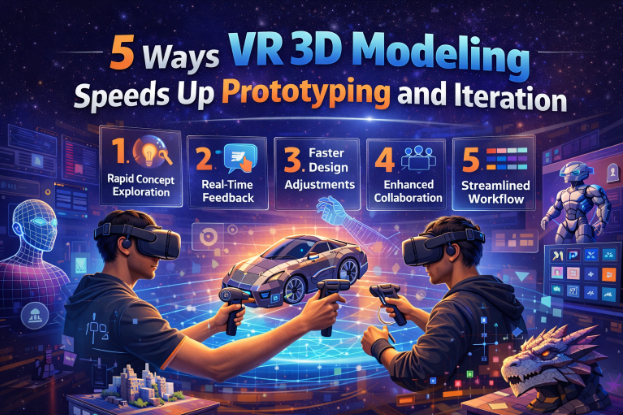

Prototyping was always the slowest part of the design process. The old way of doing things could easily include a workflow burdened with a major loop of revisions, long cycles for feedback, and constant movement back and forth between the teams.
If designers could, to their great advantage, step into their work, test ideas instantly, and change designs in real-time, the whole ordeal would be fast, clear, and above all, collaborative. Those activities that used to stretch into weeks could now practically be squeezed into days, perhaps even hours.
Real-Time Design Changes Without Rebuilding Models
One main source of endless delay with traditional prototyping is the rebuilding of models after every round of feedback. VR 3D modeling enables designers to effect changes in situ within the virtual environment.
Scale, proportions, spatial arrangement, and structural elements may be modified while being viewed, without having to export files or redo the process. This immediacy makes for a pleasant time-saving and evolution of ideas instead of being stuck in rigid phases.
Faster Feedback Through Immersive Reviews
Feedback is hardly useful when everybody is not on the same page with the design. Monitors and flat screens often fail to communicate pretty well in regard to the scale, depth, and spatial relationship.
VR removes that gap; stakeholders can walk through a prototype, going into a close examination of the details, actually experiencing the design as it must be used. That will give precise feedback with minimal misunderstanding. Fast, confident decisions are made when everyone sees the same thing in the same context.
Early Problem Detection Saves Iteration Time
Late into the process, many design errors remain hidden till a time such that changes become costly and slow to effect. VR now allows for the earlier detection of such anomalies. Everything from spatial to movement, ergonomics, or others becomes duly apparent when lived full scale.
Fixing them at this point is a real inconvenience. By correcting mistakes early, the cycled revisions required later will be drastically cut by employing VR 3D modeling.
Seamless Collaboration Across Teams
Prototyping often gets slowed down since designers, engineers, and clients tend to work within their own circles. That barrier is now taken down with a 3D visualization company. Even from other locations, a handful of members from the same team can fairly easily assess a model and discuss results.
This shared environment keeps everybody aligned and cuts down long emails and back-and-forth meetings. When engagement on collaboration happens inside the design itself, iteration then becomes a conversation form rather than just a long-drawn process.
Reduced Dependency on Physical Prototypes
Real prototypes are expensive, take a lot of time to get ready, and are difficult to change. On the other hand, virtual models from VR-based development allow teams to evaluate all their ideas without restrictions.
Designers can pursue multiple versions, compare alternatives, and refine details without any material costs or production delays. Such flexibility has established a culture of quick experimentation and informed decision-making. Once a concept is established in VR, it is turned into a physical prototype with speed and focus.
How This Impacts Modern Design Workflows
Expectedly, speed alone isn’t the only benefit; faster iteration yields better results. Teams are more inclined to venture bold ideas and thoughtfully refine them when held outside the pressures of long revision cycles.
Many studios depend on VR 3D modeling as the main factor of their modern architecture workflow; they often cooperate with an audiovisual partner who is competent in both the creative and technical aspects of immersive design. Therefore, in this case, the process is becoming more and more fluid, less limiting, and much more effective.
Conclusion
VR 3D modeling not only enhances the prototyping process but also turns around the whole team’s process of working on iterations. VV, without a doubt, has eliminated most of the bottlenecks that hold back traditional workflows through live updates, immediate feedback, prompt problem identification, and smooth cooperation.
When effectively used, VV changes the prototyping process into a rapid, agile, and very user-friendly one, thus enabling the teams to quickly go from idea to implementation while obtaining much better outputs.