
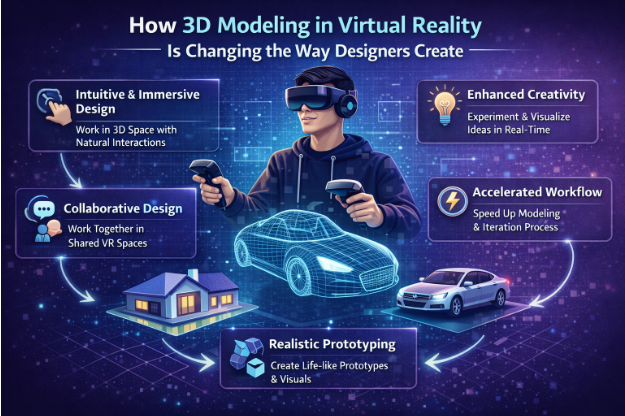

Design workflows are also seeing a paradigm shift as immersive technologies are changing the way designs are conceptualized and visualized. Conventional modeling practices may have been very effective, but are very limited in terms of creativity as they only allow work on computer screens with mouse pointers in two-dimensional models. Current developments in 3D modeling using virtual reality are now opening new avenues, as designers can walk into their designs to interact with them in three dimensions.
As industries require increased iterations, accuracy, and visual insights, the need for immersive modeling environments has become an integral part of the modern design process.
Evolution of Screen Designing from Immersive Creation
Designers have, for many years, been forced to rely on the monitor as the interface with the input devices in order to develop three-dimensional content. Although very useful, this technology allowed the designer only to think about the three-dimensional content of the image in an indirect way. The virtual reality paradigm eliminates this constraint by immersing the designer inside the image.
With 3D modeling in virtual reality, designers can see objects at scale, walk around them, and interact with elements as if they were real. This development in 3D modeling technology has brought a huge change in the process of spatial awareness and creativity in the design process.
How Immersive Modeling Enhances Creative Freedom
Creativity flourishes when there are no limits imposed upon it. Virtual reality modeling tools enable designers to sketch, shape, and change the shape of any form using the designers’ own hand motions instead of using commands.
Such intuitive interaction sparks creativity and promotes experimentation. The designers can easily come up with creative and daring designs and implement them in an instant. This leads to easier and more expressive flow of creative activity while designing, as opposed to other methods.
Real-Time Scale and Proportion Awareness
One of the biggest strengths of immersive creation lies in the fact that scaling can be more accurately determined. This is because, when objects are placed on a screen, some may look larger than others, while some may look smaller.
Now, through the process of 3D modeling in virtual reality, the designers get a firsthand experience of the design in human proportions from day one.
Faster Iteration and Design Validation
The design iteration may slow down in situations where the designs are required to be mentally or repeatedly simulated. The virtual reality modeling technique enhances the process by providing feedback.
Designers can check the forms, layouts, and structures instantly. Any problems in terms of spacing, ergonomics, and balance would be immediately obvious, and thus there would be no loss of time. The benefit of immersive modeling in complex designs can thus be seen.
Increased Collaboration and Shared Understanding
Few designs occur alone. Teams need to work, examine, and develop concepts collaboratively. With virtual reality, designers and other stakeholders interested in the model will be able to view it simultaneously.
As all are looking at the design from the same immersive viewpoint, the feedback becomes more precise and helpful. This common ground eliminates misunderstandings and syncs the team better than screen feedback can.
Enhancement of the Use of 3D Modeling Services
With the rising usage of immersive workflows, organizations begin turning towards 3D modeling services that can benefit more complex projects involving the likes of virtual reality. The need for 3D model services arises from the understanding that designers need more optimal models.
Advanced support for modeling enables the designer to concentrate on the creative aspect while ensuring technical detail. Such interaction would prove highly beneficial for those industries that are adopting the immersive workflow process for the first time.
Enhancing Design Confidence and Decisions
Design opinions matter greatly, particularly when it comes to building designs, product designs, and engineering designs. This is because designers can assess their designs through virtual reality modeling, as their designs work in VR without flaws.
When the design is evaluated in the immersive environment, potential problems are recognized more easily, which creates better decision-making and fewer surprises down the line.
Bridging The Gap Between Concept and Reality
One of the most revolutionary things about immersive creation is the way in which it bridges the distance between conception and completion. Designers no longer use imagination alone to figure out how things will feel.
In doing this, designers immediately understand how the design will be useful, look, and function in a virtual environment. Such alignment contributes to better design quality.
Encouraging Innovation in Various Industry Sectors
The realms of architecture, industrial design, entertainment, and education, among others, are being impacted by immersive workflows. There are new ways in which designers are prototyping, testing, and showing off their designs in virtual reality.
The rapid adoption of 3D modeling services is driving the evolution of these services to meet the requirements of immersive-first workflows.
The Learning Curve and Skill Development
Although immersive modeling has many advantages, there are still adjustments that a designer needs to make when working with immersive modeling. Training a designer in the immersive model essentially involves learning about space interaction, the use of gestures, and performance.
However, many designers believe that the intuitive nature of these tools helps reduce the learning curve. Moreover, these types of environments will eventually seem more intuitive than traditional interfaces.
The Future of Designer-Centered Workflows
This trend in immersive creation is not going away. Virtual reality modeling is expected to become a common part of any educational or professional process as hardware becomes more widely available and software improves.
Practitioners who incorporate immersive workflows into their designs will develop an edge over their competitors in terms of working quickly, understanding their designs more clearly, and teaming up effectively.
Final Thoughts
3D modeling in virtual reality is changing the design experience with its enhanced spatial insights, rapid collaboration, and natural interfaces. Designers are able to enter their designs and gain insights and confidence that other design solutions cannot provide for them. The growing services of 3D modeling are helping to bring the benefits of immersive design workflow to wider proportions.
With increasingly complex design challenges and exponentially rising expectations, virtual reality has become more than just a design process enabler. The reality is that virtual reality is on its way to becoming a design building block that allows designers to think big and work smart.